OceanGate: A Masterclass in How Not to Do Systems Engineering

Pari Singh
The Titan Submersible failure report is out. It's a wild masterclass in how not to build safety-critical systems. Skip the fundamentals, and nature will enforce them for you.
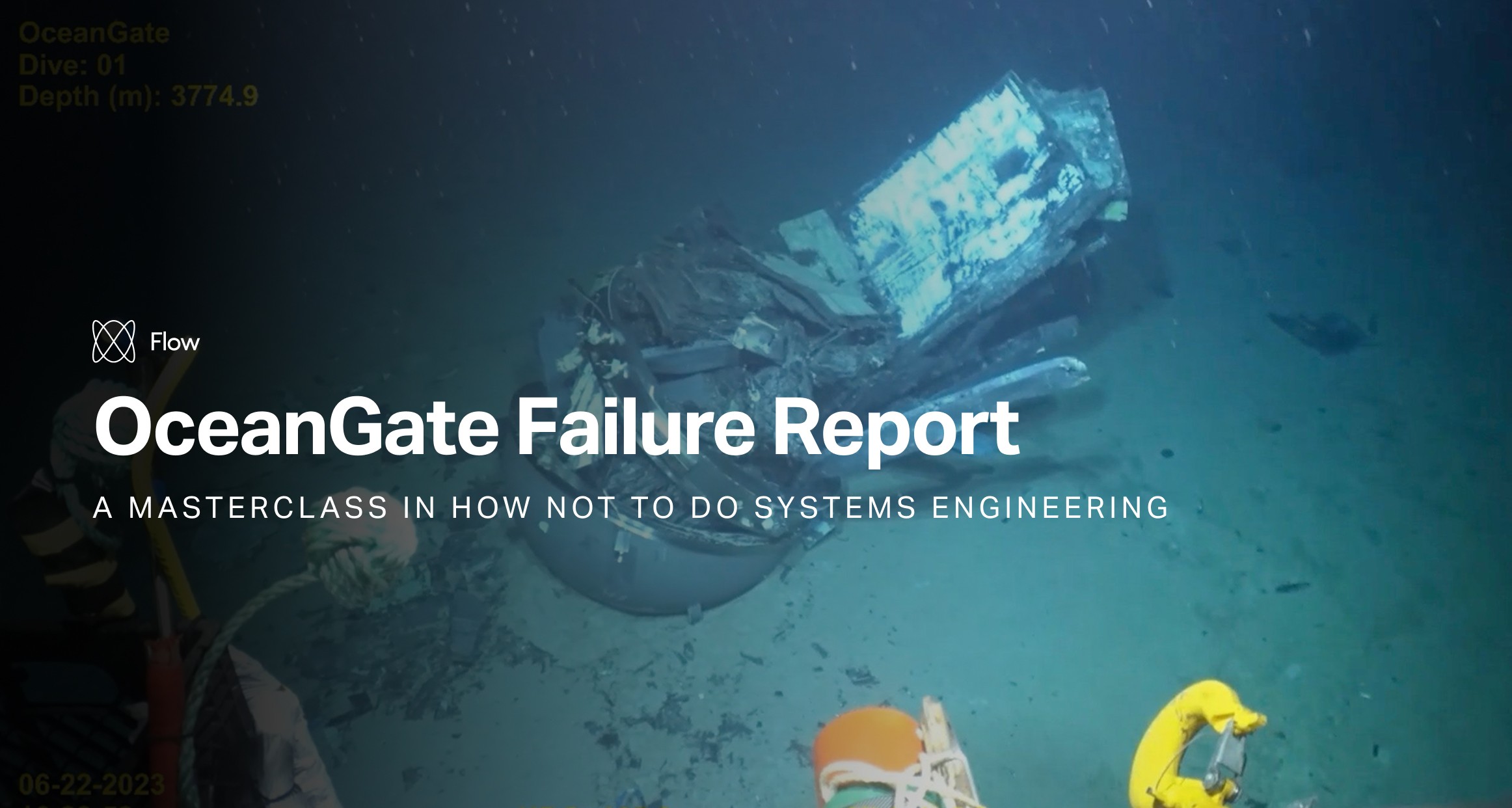
The report shows exactly what happens when engineering rigor gets replaced by vibes and a few sensors:
1. Never, ever skip testing.
I have a lot of feelings about choosing carbon fibre for a submersible (WTF?!).
But innovation demands iteration. You can try new materials if you test them properly. OceanGate didn’t.
They skipped full-scale pressure testing entirely. No qual tests. No hull proof testing to industry norm of 1.25–1.5× rated depths. Just a 1/3 scale model and a few dives.
Their fallback? Real-time sensors with no thresholds, no abort criteria, and no documented response plan.
Testing is cheap enough to just do. So we should just do it and build it into every cycle. Real data beats guesswork.
It’s the cheapest form of safety we have.
2. Certification ≠ Safety. But it helps.
People will point out that there was no certification.
But here’s the truth: certification alone doesn’t guarantee safety. Discipline in engineering, testing, and risk management does.
Even if they had pursued cert (they wouldn’t have passed), they were going about engineering all wrong.
They skipped the entire mindset behind certification: No system. No rigor. No evidence of safety. Full stop.
Iterative teams don’t build for certification. They build for evidence so when cert time comes, they’re not guessing, but showing proof.
3. FMEA is non-negotiable for human-rated systems.
No FMEA (Failure Modes & Effects Analysis) is wild.
Report confirms it. No formal failure analysis. No structured risk mitigation. Just hope, hubris and sensor dashboards.
There was no systematic effort to answer: What might fail? How would we know? What happens next?
For a human-rated submersible operating in an extreme environment (3,800m), that's incomprehensible.
Every student rocketry team runs a tighter process.
OceanGate's approach wasn’t just risky. It was reckless. They ignored every basic principle of engineering discipline.
The result: a catastrophic failure that killed five people.
Novelty in design is not a reason to bypass fundamentals. It's a reason to double down on them.
When the environment is unforgiving, the only margin that matters is the one you've proven in advance.